
Introduction
The online world has completely altered the manner in which organizations communicate with their audience. Those days are long gone when posting an advertisement on a billboard or in the local newspaper used to be enough to grab market share. Social media is now the pulse point for all brand interactions and has become a dynamic and round-the-clock marketing and sales channel. As this environment has evolved and grown, it has also become more and more complicated. It is now far more than "posting content."
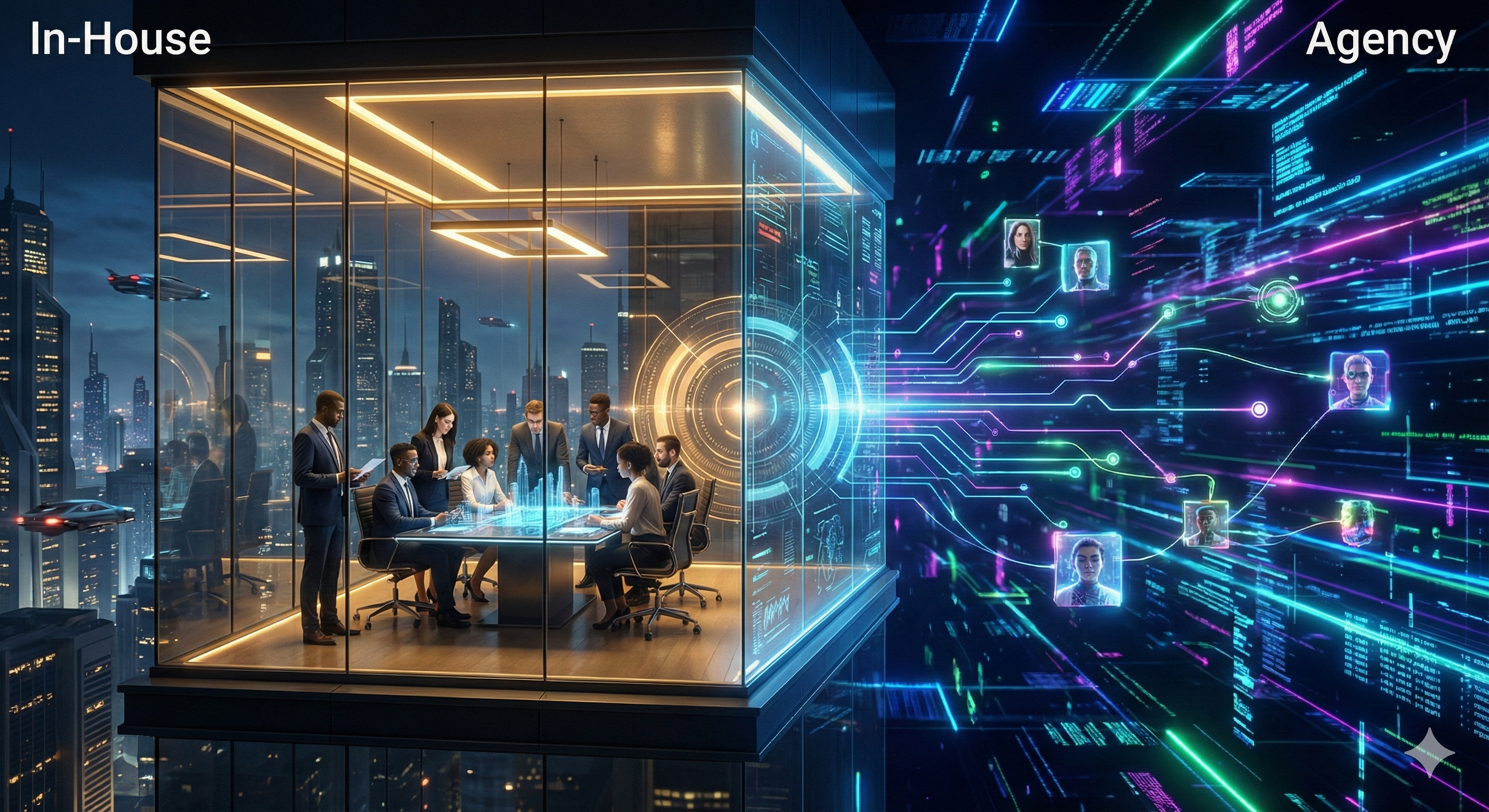
For the business owner or marketing executive, this complexity gives rise to a critical dilemma: How do we effectively manage this task? Should we create an entire team for ourselves, within the four corners of our company, where our very own employees are breathing our brand's culture every single day? Or should we delegate this task to an external company, an entire team of “mercenaries” equipped with the best technology and the broadest possible knowledge of the industry? This question goes beyond the boundaries of being an “operation.” It's actually a “strategy.” It affects your budget, flexibility, content quality, and ultimately, your brand's voice. This in-depth analysis will attempt to break down the “Social Media Management vs. In-House” discussion for your benefit.
1. Defining the Models: What Are We Comparing?
However, it would be best to first define the specifics of each model before exploring the details.
In-House Marketing TeamsAn in-house team is composed of people who work for your business. They are your employees. They work from your office and from your home office setup. They answer to you.
- The Structure: This can be a single “Social Media Manager” doing many jobs to a full department of copywriters, designers, and social media leads.
- Their Focus: Their focus is undivided. They do not have multiple clients to handle; they go to bed with your brand on their minds.
An agency refers to an external collaborator—an independent business organization that you pay on a contract or retainer basis to take care of your marketing activities.
- The Structure: Agencies are structured like a network of experts. When you hire an agency, you’re not hiring one person; you’re theoretically gaining access to an entire network of strategic thinkers, creative directors, and data analysts.
- The Focus: They handle several clients at the same time. This is because they operate using an approach that emphasizes efficiency and the adoption of best practices from various sectors to get results for you.
2. Cost Analysis: The Financial Implication
More often than not, the conversation begins, and frequently ends, with the budget. Yet, the comparison between the cost of a retainer and the salary of an employee is not necessarily an accurate comparison.
The Real Price of In-House DevelopmentAt first glance, the hiring of an internal employee may seem transparent. It costs money. The hidden costs of an employee are very high.
- Salaries: The going rate for an experienced Social Media Manager is quite high. Senior strategists or creative directors can be much more expensive.
- Overheads: You need to include costs for FICA taxes, health insurance premiums, 401(k) plan contributions, and paid vacation time.
- Recruitment and Training: It costs money and time to recruit the right candidates. After recruitment, it is necessary to train them to keep them updated about the changes in the platform.
- Equipment: Computers, office facilities, and specialized equipment.
Agencies typically operate on a monthly retainer model. They usually work on a monthly retainer fee arrangement.
- Predictability: You pay a flat fee for a scoped set of deliverables (for example, 15 posts a month, community management, monthly reporting).
- Efficiency: You are not paying for their health insurance or office space or downtime. You are paying them solely for their output and their expertise.
- Scalability: When budget constraints begin to affect organizations, it is more feasible to put the contract with the agency on hold than to have to terminate the employee and pay the resulting severance package.
3. Skill Set and Expertise: Generalist vs. Specialist
It is at this point that the trade-off becomes most evident. Social media demands a wide range of skills, including writing, graphic design, video editing, data analysis, and understanding consumer psychology.
The "Unicorn" Problem (In-House)In the case of assembling a team within the company, and especially when it comes to small and medium businesses, the tendency is to hunt for a “Unicorn,” a person who can do everything. You hire a Social Media Manager and expect them to be a master of writing clever captions, a professional at designing graphics fit to be on billboards, a video editor worthy of a film director’s skills, and a data analyst on par with a mathematician.
- The Reality: People like this are scarce and pricey. More likely, you are hiring a generalist who is “good enough” at most everything but a specialist in nothing or burn them out.
- The "Brand Blindness" Risk: In-house agencies have a deep understanding of company culture. That is a huge positive. But they could be blind to market trends. They are so immersed in the company world that they aren’t seeing the bigger picture.
They are founded on specialization.
- Depth of Talent: While your account manager may be strategic, the graphics are created by a professional Designer, and the reels are cut by a Video Specialist. You get the benefit of the talent of five individuals, not the full talent of one generalist.
- Cross-Industry Insight: Agencies get data from twenty different clients. They know what works now on Instagram because they tested it yesterday on another account of theirs. They offer fresh insights and can recognize trends that your business may not yet see.
4. Access to Tools and Technologies
The contemporary marketing stack costs money. To manage a business-grade social media presence effectively, you will need more than the Instagram app.
The Tech Stack Bill- Scheduling & Analytics: Software such as Sprout Social, Hootsuite, or Buffer (Cost: $200-$500/month).
- Design & Video Software: Adobe Creative Cloud, Canva Pro, Stock Footage Licenses (Cost: $100+/month).
- SEO & Listening: SEMrush, Ahrefs, Social Listening Tools Price: $200+ per month
In-House: In-house solutions mean that you pay for 100% of the licensing costs. It costs thousands of dollars a year for a single employee.
Agency: Agencies are spreading these costs across all of their clients. Agencies are “power users,” leveraging enterprise-level access to solutions which might be cost-prohibitive to a single company. By contracting with them, you are essentially absorbing their tech stack without it showing up as an expense.
5. Scalability and Continuity
Business will rarely be static. You will have your busy seasons and your slow seasons.
The In-House Rigidity- Scaling Up: If you are doing a huge product launch, your single employee cannot handle it. They have only 8 hours a day. If you want to do more, you have to employ more people. That takes months.
- The "Bus Factor": Suppose your Social Media Manager becomes sick, goes on maternity leave, or simply quits. Your marketing stops. Their expertise goes out the door with them. Employee turnover for in-house marketing is extremely high.
- Scaling: There is a need for 20 additional videos for Christmas. The company can scale from other squads in the organization.
- Continuity: Agencies are system-dependent, not person-dependent. Even if your account manager leaves, you are assigned a new one. Your assets, passwords, strategy, and so on are secure in their system. Nothing stops.
6. Communication and Control: The Human Element
This is the strongest point in favor of having in-house teams and also the point that has created the greatest tension between agencies and in-house teams.
The “Hallway Conversation” (In-House)- Speed: “Walk on over and say, ‘Hey, let’s put up this picture of the CEO right now,’”
- Culture: They document the unplanned moments, the office birthday cake, the chaos behind the scenes. This is something you can't fake.
- Alignment: They are in attendance at your weekly meetings. They are intimately aware of the politics that play out in your product roadmap.
- Distance: An agency can never really understand your office culture because they are not physically present. They depend on the resources that you provide them. If you do not provide them with pictures of your team, they won’t be able to put them on their page.
- Control: You voluntarily cede control to the contractor or consultant. They possess expertise, and you must rely on it. This can be a painful process for the micromanager.
7. Making the Decision: Which is Right for You?
Of course, there isn’t a one-size-fits-all “better” solution. It all depends on your company’s life cycle and objectives.
Choose an In-House Team If:- Your Industry is Highly Regulated: When all postings require legal checks for compliance issues (for example, finance and healthcare), having an insider is safer.
- Content Must Be "Live": In case your strategy includes daily video blogging, office culture recording, or reaction to news events.
- You Want Total Control: You want to control every pixel and caption before it goes out.
- You Have a Large Budget: You can hire a team of 3-4 people (Writer, Designer, Manager) to duplicate the skill set of an ad agency.
- You Require Fast Results: You need to be able to implement your strategy as soon as possible and need results next week, and not in three months after hiring.
- You Lack Internal Expertise: “You don't know how to hire or how to manage a social media person because you're not sure what 'good' is.”
- You Need Specialization: "You need high-end video production or complex ad management that a generalist can’t provide."
- You Want to Reduce Risk: You do not want the headache of HR issues and turnover.
Future Trends: The Hybrid Model
Interestingly, there is a shift towards a middle ground in the market. Many successful firms are implementing a Hybrid Model.
- They also hire a junior ‘In-House Content Creator’ who is often from Gen Z and is tasked with the responsibility of creating content by filming TikTok videos on an iPhone.
- They work with an Agency for Strategy and Ads. The agency will take the raw content and turn it into something more polished and strategic, and do the technical ad campaigns and big-picture reporting. This provides the best of both worlds: the real, fast capture of the cultural element through an employee, and the strength and technical expertise of an agency.
Conclusion
Whether to handle the marketing internally or through a social media agency is a trade-off between Control/Culture and Expertise/Efficiency.
If your brand is based upon your raw, everyday, personality-driven content, then the cost of having your own in-house person is priceless. Nobody can be you better than you. But if you are looking to scale in a precise, technical, and headache-free manner regarding growing your HR department, an agency is a one-stop solution which brings a wealth of talent to your doorstep for a certain cost.
At the end of the day, it is the same thing. Reaching your target is what matters. It is not important that you drive a sedan or have a limo service. It is important that you reach your target. Take a good look at your internal resources. Can you handle a creative department? Can you afford to have the equipment? If not, then a creative agency is just what you need to tap into your online potential.